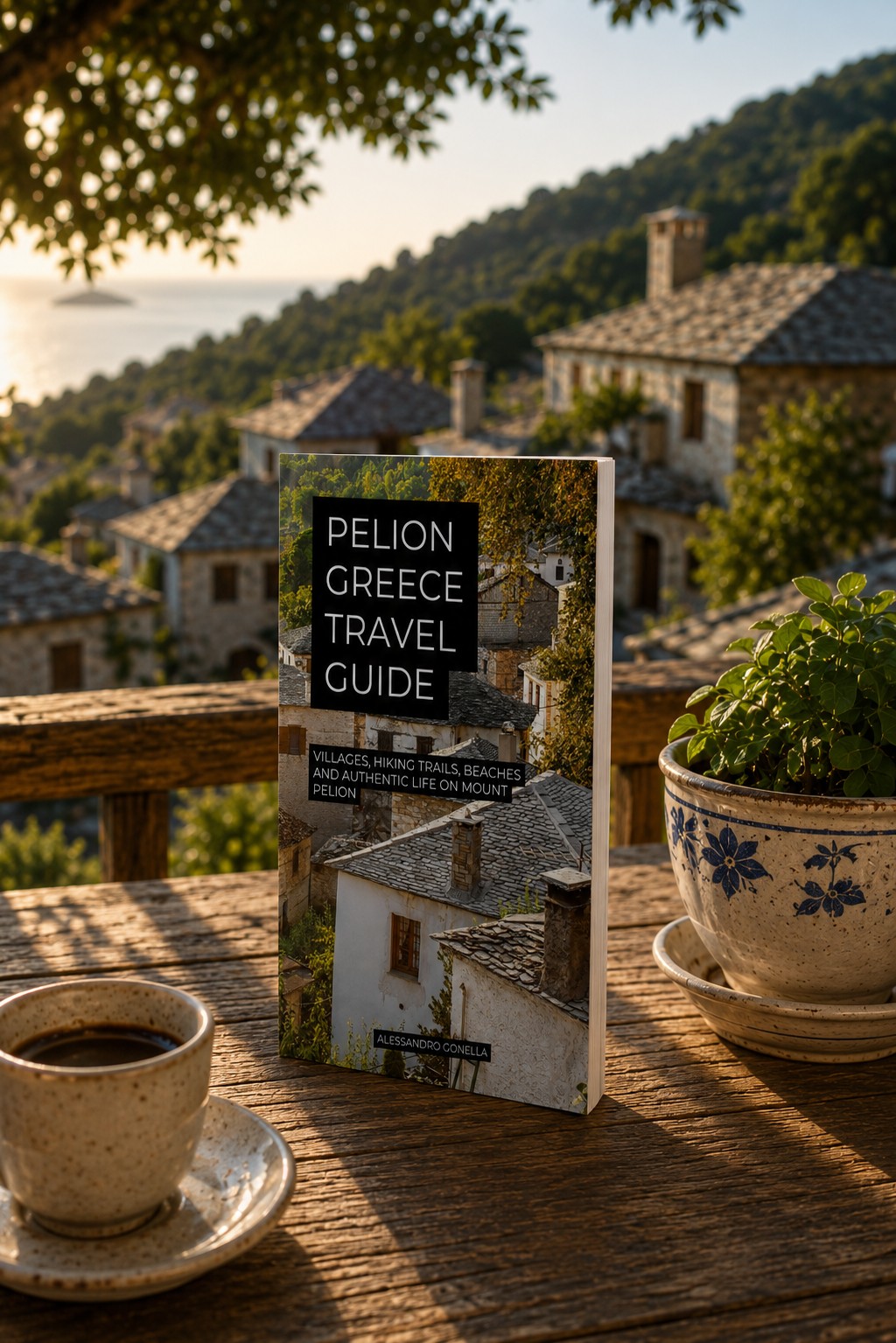
Villages, hiking trails, beaches, and authentic life on a peninsula most guidebooks skip entirely — written from decades of lived experience, not a weekend visit.
The guide itself moves region by region — gateway villages, the mountain core, the eastern villages, the wild south, the coast. What ties them together is the terrain: Pelion rises from sea level to over 1,600m, often within a short distance — which is why roads wind, distances are felt in time rather than kilometers, and villages sit at very different heights above the same two seas.
Centuries-old stone paths wide enough for pack animals, built to connect villages, fields, and ports long before roads existed. Chestnut, oak, beech, and plane forests. Village-to-village walks, mountain trails, and steep coastal descents, graded by difficulty rather than distance.
The historical and cultural core of Pelion — stone mansions, cobbled squares, and in Milies, a heritage railway originally built to move goods, not tourists. Each village profiled for who it actually suits, not just what to photograph.
A cluster of squares and settlements set among ancient plane and chestnut forests, with footpaths descending to the small natural harbor at Damouchari on the Aegean coast.
The first introduction to Pelion for most travelers coming up from Volos — accessible, atmospheric, and a practical base for those without a car.
Pelion sits between two very different coastlines, often reachable on the same day.
Wild, exposed, deep blue water. Stronger winds, steep access, dramatic landscapes. Best for confident swimmers.
Calm, sheltered, warmer water. Easier access, longer swimming seasons. Ideal for families and casual swims.
— paraphrased from the book's own preface. It was written to explain Pelion honestly, not to oversell it.
Get the book on AmazonPelion is not a place you "tick off" a list. It is a region that reveals itself slowly, through its villages, paths, forests, and coastline. It requires curiosity, patience, and a willingness to move beyond the obvious.
Pelion is well known to Greek travelers, but information in English is often fragmented, outdated, or superficial. This guide was written to close that gap — not by selling Pelion as a hidden paradise, but by explaining it clearly: how it works, how to move through it, and how to experience it with respect.
Alessandro Gonella is Italian by birth, but Pelion has been part of his life for as long as he can remember — every summer, year after year, more a place of return than discovery. He is now forty, and his experience of the region spans childhood, adolescence, and adulthood.
No promotional language. No idealized itineraries. Just what to expect, who each village and beach actually suits, and how to plan around a region that moves at its own pace.
Available in paperback and Kindle. Read it before you go, or bring it with you.
Get the book on Amazon